1. Basic Standard & Material Introduction
Applicable Standard: EN 10025-2, European standard low-alloy high-strength structural steel Domestic Equivalent Grade: Q355B; Former Grade: St52-2
Grade Code Definition:
- S = Structural Steel
- 355 = Minimum yield strength of 355 MPa for plates ≤16 mm thick
- JR: Charpy V-notch impact test at 20°C with minimum impact energy of 27 J, delivered in hot-rolled condition
2. Complete Performance Parameters of S355JR
2.1 Chemical Composition (Ladle Analysis, wt%)
表格
| Element |
Maximum Content |
Remarks |
| C (Carbon) |
≤0.22 |
Low carbon content, excellent weldability; Carbon Equivalent: 0.42~0.47 |
| Si (Silicon) |
≤0.55 |
Deoxidizer, improves tensile strength |
| Mn (Manganese) |
≤1.60 |
Matrix strengthening, enhances toughness |
| P (Phosphorus) |
≤0.025 |
Harmful impurity, strictly controlled to avoid cold brittleness |
| S (Sulfur) |
≤0.025 |
Tightly limited to prevent hot cracking |
| N (Nitrogen) |
≤0.012 |
Restricts free nitrogen to avoid aging embrittlement |
| Cu (Copper) |
≤0.55 |
Trace addition improves atmospheric corrosion resistance |
2.2 Mechanical Properties (Hot-rolled, Room Temperature 20°C)
(1) Minimum Yield Strength ReH, Tensile Strength Rm & Elongation A5
表格
| Plate Thickness t |
Min Yield Strength (MPa) |
Tensile Strength Rm (MPa) |
Elongation A5 ≥ |
| 3<t≤16 mm |
355 |
470~630 |
22% |
| 16<t≤40 mm |
345 |
470~630 |
22% |
| 40<t≤63 mm |
335 |
470~630 |
21% |
| 63<t≤80 mm |
325 |
470~630 |
21% |
| 80<t≤100 mm |
315 |
470~630 |
20% |
(2) Impact Toughness
- JR Grade: Charpy V-notch impact test at 20°C; Single specimen impact energy ≥27 J, average value ≥34 J
(3) Fundamental Physical Properties
- Density: 7.85 g/cm³
- Hardness (Hot-rolled): HB 140~180
- Elastic Modulus E: 206 GPa
- Thermal Conductivity: 46 W/(m·K)
- Linear Thermal Expansion Coefficient: 12×10⁻⁶ /°C
2.3 General Machining Characteristics
- Weldability: Excellent low carbon equivalent. Thin plates require no preheating; preheating is mandatory for thick plates to prevent cracking.
- Cold Forming: Bendable and stampable. Minimum bending radius ≥2t, larger springback than Q235 steel.
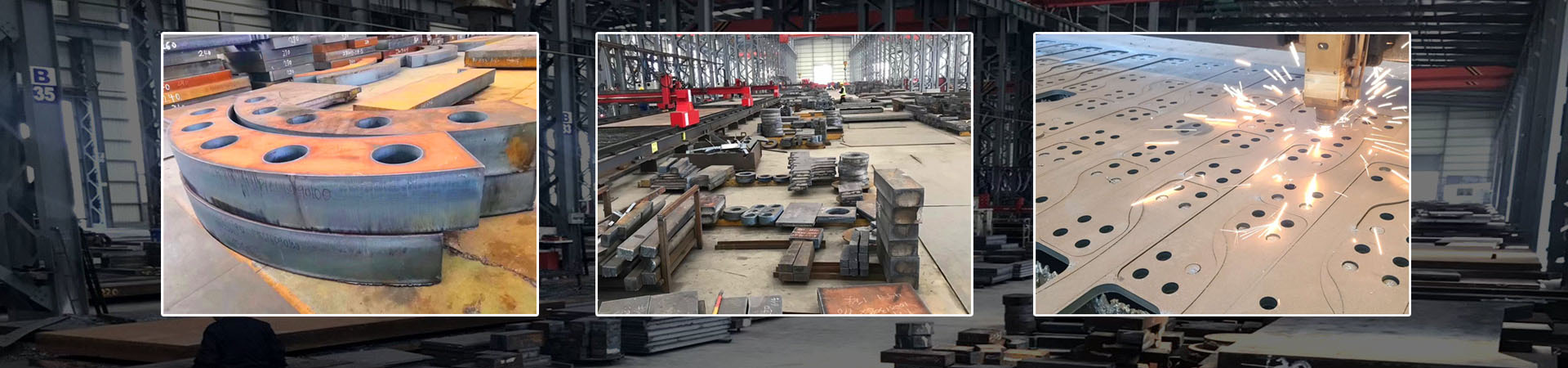
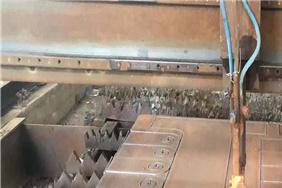
- Cutting Compatibility: Fully compatible with flame cutting, plasma cutting, laser cutting and waterjet cutting. Preheating is required for thermal cutting of thick plates.
3. Four Main Cutting & Processing Methods for S355JR
(Applicable thickness, process parameters, advantages, disadvantages and operational key points)
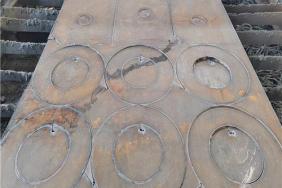
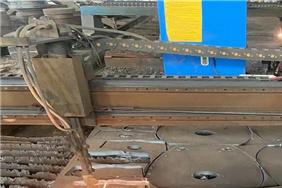
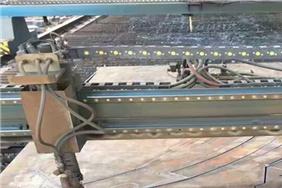
3.1 CNC Flame Cutting (Oxy-propane / Oxy-acetylene)
Applicable Thickness: 10~300 mm extra-thick plates (max cutting thickness up to 1000 mm)
Core Process Parameters
- Oxygen pressure: 0.7~1.0 MPa; Fuel gas pressure: 0.05~0.12 MPa
- Plates ≥40 mm: Preheat to 100~150°C to avoid hydrogen-induced cracks at cutting edges
- Cutting speed: 180~220 mm/min for 20 mm plate; 80~120 mm/min for 100 mm thick plate
- One-step bevel forming: 30°~45°, suitable for blanking before welding
Advantages
Low equipment cost; the most economical solution for extra-thick plates; mass production of heavy-duty bases, flanges and bearing housings.
Disadvantages
Wide heat-affected zone (5~10 mm); dross adheres to cutting surface; dimensional tolerance ±1~3 mm; thin plates prone to burn-through; workpieces suffer severe thermal deformation.
Exclusive Operation Notes for S355JR
Cover cut workpieces with thermal insulation cotton and cool slowly to room temperature after cutting. If ambient temperature <5°C, raise preheating temperature to 150~200°C to prevent microcracks at edges within 48 hours post-cutting.
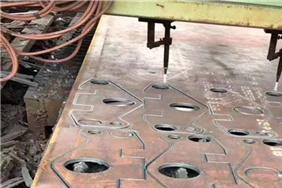
3.2 Fine Plasma Cutting (High-precision)
Applicable Thickness: 3~40 mm medium & thin plates, mass production of special-shaped parts
Process Parameters
- 10 mm S355JR: Current 160~190 A, cutting speed 300 mm/min, compressed air / oxygen auxiliary gas
- 20 mm S355JR: Current 200~240 A, cutting speed 240~280 mm/min
Advantages
Much faster cutting speed than flame cutting; good verticality of cutting surface; dimensional tolerance ±0.5 mm; capable of complex holes and special contours.
Disadvantages
Sharp cost increase for plates over 40 mm; thin hardened layer forms on cutting surface, which must be ground off before welding for thick plates.
3.3 Fiber Laser Cutting (High-precision Finishing)
Applicable Thickness: 0.5~25 mm thin plates for precision components (gears, machine casings, thin-plate construction machinery accessories)
Process Parameters
- 3~6 mm: 2000 W laser power, cutting speed 2~4 m/min, oxygen auxiliary for burr-free cross-section
- 10~16 mm: 6000 W laser power, cutting speed 0.6~1.2 m/min
- 16~25 mm: 12000 W high-power laser with low cutting speed
Advantages
Highest dimensional accuracy (±0.05~0.2 mm); minimal heat-affected zone; narrow kerf; negligible thermal deformation; smooth cutting surface with no secondary grinding required.
Disadvantages
High initial equipment investment; low efficiency and high cost for plates thicker than 25 mm compared with flame cutting.
3.4 Waterjet Cutting (Thermal-stress-free Cutting)
Applicable Thickness: 0~200 mm, parts requiring zero thermal deformation and no hardened layer
Process Parameters
Water pressure: 360~420 MPa; 80~120 mesh garnet abrasive
Advantages
Zero heat-affected zone; no cutting hardening or cracks; workpieces can be bent or machined directly after cutting, ideal for precision pressure-bearing structural parts.
Disadvantages
Slowest cutting speed; highest processing cost; poor cost performance for large-size blanking.
4. Process Selection Table for S355JR by Plate Thickness
表格
| Plate Thickness |
Recommended Cutting Method |
Application Scenarios |
| ≤10 mm thin plate |
Fiber Laser Cutting |
Precision machinery, thin-plate construction machinery parts, mass small-hole components |
| 10~30 mm medium plate |
Fine Plasma Cutting |
Flanges, special-shaped connecting plates, standard steel structure parts |
| 30~300 mm thick plate |
CNC Flame Cutting |
Bearing housings, equipment bases, thick flanges, bridge auxiliary components |
| All thicknesses, zero thermal deformation required |
Waterjet Cutting |
Precision molds, pressure-bearing structural parts, parts requiring subsequent cold working |
5. General Quality Control Points for S355JR Cutting
- Crack Prevention for Thick Plates: Preheat plates ≥40 mm to over 100°C; increase preheating temperature in low-temperature environments and adopt slow cooling after cutting.
- Hardened Layer Treatment: A 1~3 mm hardened layer exists on edges cut by plasma or flame. Grind it completely before welding to avoid brittle welds.
- Blanking Sequence: Cut internal holes first, then outer contours to release internal stress and prevent plate warpage.
- Z-direction Performance Steel (S355JR-Z15/Z25/Z35): Adopt low cutting speed and avoid rapid quenching to prevent cross-section lamination and tearing.
- Post-cutting Procedures: Remove burrs and molten slag; inspect dimensional tolerances; high-stress components may undergo stress relief annealing at 530~580°C to 580°C.
6. Typical Application Fields
Heavy machinery bases, steel plant building beams and columns, crane arms, bridge auxiliary parts, flange plates, bearing housings, construction machinery boxes, non-pressure-bearing shells for pressure vessels, etc.