1. Main Materials of Crane Base (Classified by Lifting Capacity & Working Conditions)
Crane bases bear alternating loads, impact loads and ground extrusion forces, categorized into three types: general load-bearing structural steel, high-strength heavy-duty steel and wear-resistant lining plates. Below are domestic and equivalent European standard grades.
1.1 Small & Medium Overhead/Gantry/Truck Crane Base (≤50t, Conventional Indoor Service)
| GB Grade |
Execution Standard |
Yield Strength |
Application Scenarios |
Equivalent European Grade |
| Q235B |
GB/T700 |
235MPa |
Light-duty small crane bases, auxiliary supports, simple pedestals |
S235JR |
| Q355B/Q355C/Q355D |
GB/T1591-2018 |
355MPa |
Main bases for 8–50t gantry cranes, overhead cranes and truck-mounted cranes (most widely used in the industry) |
S355JR/S355J0/S355J2 |
| Q355NE |
GB/T1591 |
355MPa |
Outdoor port cranes used in low-temperature northern regions, qualified for impact test at -20℃ |
S355NL |
1.2 Heavy Crawler Cranes / Portal Harbour Cranes (50t–300t Heavy-Duty Base)
| GB High-Strength Steel |
Yield Strength |
Core Advantages |
Equivalent European Grade |
| Q420NE |
420MPa |
15% thinner plate thickness under identical loads for lightweight design, excellent weldability |
S420NL |
| Q550D/Q550E |
550MPa |
Base outriggers and main box girders of medium & heavy crawler cranes |
S550Q/S550QL |
| Q690D/E |
690MPa |
Main bases of large tonnage cranes above 200t, load-bearing box structures; good low-temperature toughness at -40℃ |
S690Q/S690QL |
| WQ590DE (Normalized & Tempered Plate from Wuyang Iron & Steel) |
590MPa |
Special base steel for mining cranes in frigid areas |
S590Q/S590QL |
| Q960D/Q960E |
890MPa |
Lightweight bases for super-large cranes over 300t |
S960Q/S960QL |
1.3 Wear-Resistant Lining Plates for Base Bottom
NM400, NM450, NM500 wear-resistant steel plates (GB/T24186), Brinell hardness 400–500HBW. Applied to anti-slip and anti-abrasion contact areas between base bottom and ground, only used for partial splicing instead of integral base load-bearing structures.
Key Material Selection Guidelines
- Low-alloy high-strength structural steel is prioritized for integral bases for balanced strength, fatigue resistance and weldability.
- Wear-resistant plates shall only serve as partial liners; full wear-resistant plates cannot be used for load-bearing bases due to insufficient toughness and risk of fracture.
- Grades C/D/E with guaranteed impact toughness are mandatory for outdoor service below -20℃.
2. Four Main Cutting Processes for Crane Bases (Comparison & Applicable Conditions)
Base plate thickness ranges from 10mm to 120mm, mainly for blanking of oversized profiles, special-shaped clamping grooves, circular arcs and welding bevels. Comparison of four cutting processes is as follows:
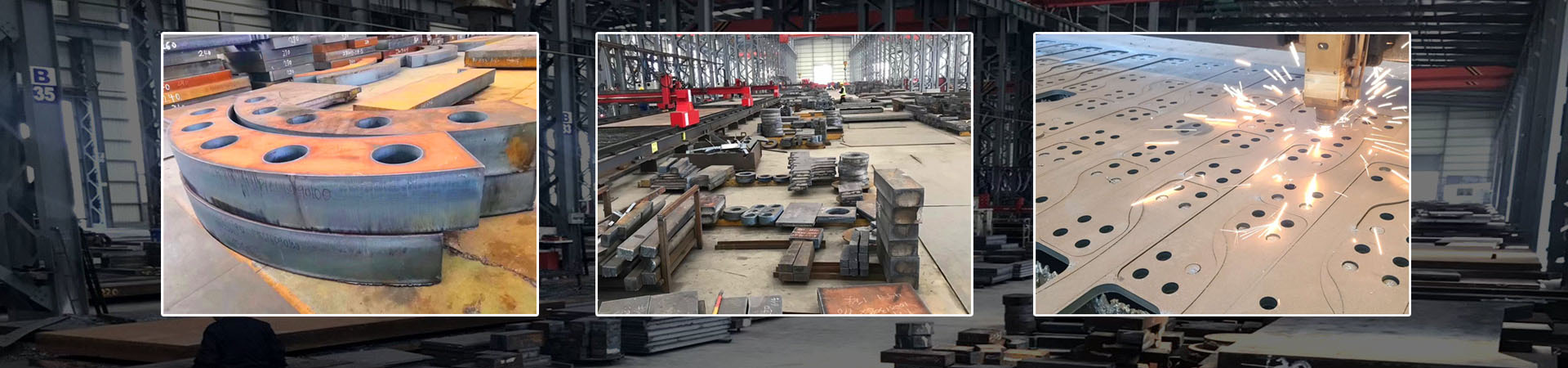
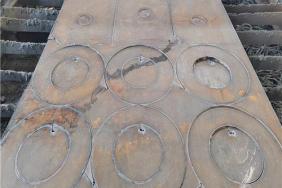
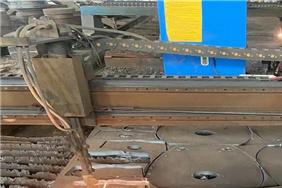
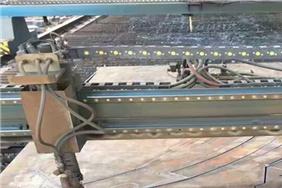
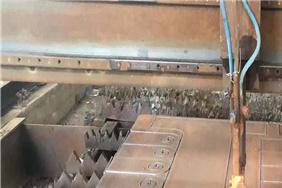
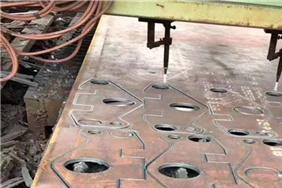
2.1 CNC Flame Cutting (Oxy-Propane / Oxy-Acetylene Cutting, Preferred for Base Blanking)
Working Principle
Preheating by 3000℃ fuel gas, followed by high-pressure oxygen jet to oxidize and blow away molten slag. Only applicable to carbon steel and low-alloy high-strength steel (Q355/Q690 etc.); not suitable for wear-resistant steel or stainless steel.
Applicable Plate Thickness
10–300mm extra-thick base plates, oversized rectangular blanks, one-step forming of welding bevels.
Advantages
- Maximum cutting thickness limit, lowest material & operation cost, low equipment investment;
- V/X welding bevels can be cut simultaneously, eliminating secondary machining before base assembly welding;
- Compatible with 12m ultra-long base steel plates, mass blanking with multiple cutting torches synchronously.
Disadvantages
Wide heat-affected zone, slag adhesion on cutting edge and minor thermal deformation; moderate dimensional accuracy. Grinding and flaw detection are required for critical load-bearing components after cutting.
Typical Crane Base Applications
Blanking of thick plates for heavy-duty main bases, outrigger base slabs, box side panels and mass rough cutting.
2. CNC Plasma Cutting (Air Plasma / Fine Plasma)
Working Principle
Metal melting via 20,000℃ plasma arc, compatible with carbon steel and NM wear-resistant plates.
Applicable Plate Thickness
6–60mm medium & thin base plates, special-shaped wear-resistant lining plates NM400/NM500.
Advantages
Much faster cutting speed than flame cutting, less thermal deformation on thin plates; capable of cutting wear-resistant liners and stainless steel accessories.
Disadvantages
Sharp cost increase for plates thicker than 60mm, poor verticality of cutting face; nitrided hard layer forms on cutting edge. The hardened layer must be ground off for high-strength steel to avoid welding cold cracks.
Applicable Scenarios
Base wear-resistant liners, thin-plate bases for small cranes, special-shaped arc clamping groove parts.
2.3 Fiber Laser Cutting (High-Precision Small Base Components)
Applicable Plate Thickness
0.5–20mm thin plates, rarely used for thick main base structures.
Advantages
Ultra-high dimensional accuracy (±0.05mm), smooth slag-free cutting edges and minimal thermal deformation; one-step forming of complex round holes and irregular profiles.
Disadvantages
Extremely high cutting cost for plates over 20mm; incapable of machining extra-thick base slabs above 100mm.
Applicable Scenarios
Base connecting plates, lifting lugs for small cranes, precision positioning mounting plates.
2.4 Mechanical Shearing via Guillotine Shear
Only applicable to straight-line simple rectangular thin plates (≤12mm). Cannot cut circular arcs or welding bevels, almost unused for large crane base manufacturing.
3. Standard Cutting Process Flow for Crane Bases (Critical Specifications for High-Strength Steel)
3.1 Pre-Cutting Preparation
- Plate flattening: Eliminate rolling deformation to prevent out-of-tolerance flatness of finished bases after cutting;
- Rust & oxide scale removal on steel surface to avoid tempering and slag adhesion during cutting;
- Carbon equivalent check for high-strength steel (Q690/S690). Stress relief treatment is mandatory if carbon equivalent exceeds 0.4%.
3.2 Standard CNC Flame Cutting Operation (Mainstream Process for Bases)
- Nesting programming: Optimize material utilization via shared-edge cutting for large base components;
- Preheating specification: Extend preheating duration for Q690 high-strength steel plates ≥50mm thick to prevent hardened layers on cutting edges;
- Cutting nozzle selection: No.2 nozzle for 10–40mm plates, No.3 nozzle for 40–100mm plates, special heavy-duty cutting torches for plates over 100mm;
- Integrated bevel cutting: One-step forming of V-type assembly welding bevels, surface roughness of bevels to meet welding requirements;
- Post-cutting finishing: Remove bottom slag, grind off hardened layers on cutting edges (compulsory for all high-strength steel).
3.3 Critical Post-Cutting Procedures for High-Strength Steel (Prevent Base Cracking)
- Large bases made of Q550/Q690/S690 high-strength steel: Low-temperature stress relief annealing (200–300℃ holding) to eliminate residual thermal cutting stress;
- Repair welding and grinding are required for cutting surface grooves or notches deeper than 1mm; 100% visual flaw detection shall be implemented for load-bearing bases;
- Grind off nitrided hardened layers on edges of plasma-cut wear-resistant plates to avoid cold welding cracks.
4. Cutting Process Selection Table for Crane Bases
| Base Type |
Plate Thickness |
Recommended Cutting Process |
Alternative Process |
| Light-duty 5–10t Overhead Crane Base |
6–20mm |
Fiber Laser Cutting (High Precision) |
Fine Plasma Cutting |
| Conventional 5–50t Gantry / Truck-Mounted Crane Base |
12–60mm |
CNC Flame Cutting |
Plasma Cutting (For Wear-Resistant Liners Only) |
| Main Base of Crawler / Harbour Cranes Above 50t |
60–120mm |
Heavy-Duty CNC Flame Cutting |
No Viable Alternatives |
| NM400 Wear-Resistant Liner at Base Bottom |
8–30mm |
Fine Plasma Cutting |
Flame Cutting Is Not Allowed |
| Precision Lifting Lugs & Mounting Connection Plates for Bases |
≤16mm |
Fiber Laser Cutting |
Low-Power Plasma Cutting |
5. Quality Acceptance Standards (Industry Specification T/CPARK 35—2023)
- Cutting surfaces of critical load-bearing bases shall meet Class I cutting quality; verticality tolerance ≤3mm for 100mm thick plates;
- Base flatness after cutting: ≤1mm per meter length;
- No cracks, delamination or deep grooves permitted on cutting edges of high-strength steel;
- Tolerance of bevel angle and width: ±1.5°, compatible with submerged arc welding / MAG welding processes.