1. Common Materials for Machine Bases (Classified by Load Capacity & Equipment Type)
1.1 Light-duty Equipment Bases (Small Machine Tools, Fans, Conveyors, Control Cabinet Bases)
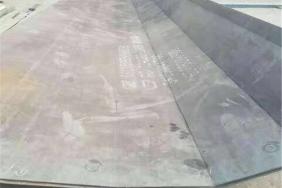
- Q235B Mild Carbon Steel Plate Most cost-effective, easy to cut, weld and machine, medium toughness for general loads, poor rust resistance; painting is required. Common thickness: 10–30 mm.
- S235JR (European Standard, Widely Used for Export Products) Equivalent to Q235B, standard material for European machine bases with improved low-temperature toughness.
- Checker Plate Anti-slip base for compact equipment, thickness 3–8 mm, only used as load-bearing floor without heavy loads.
1.2 Medium & Heavy-duty Equipment Bases (Lathes, Milling Machines, Pump Bodies, Air Compressors, Small Construction Machinery Frames)
- Q355B Low Alloy High Strength Steel (Replacement of 16Mn) 30% higher strength than Q235B, anti-deformation, suitable for 20–80 mm thick bases; mainstream material for machine tool and pump bases with favorable weldability.
- S355JR / S355NL European high-strength steel for exported equipment bases; select S355NL for low-temperature working conditions.
- Cast Iron HT200 / HT250 Integrally cast base featuring excellent vibration damping and rigidity, specially applied to precision machine tools and grinders. Formed by sand casting instead of plate cutting.
1.3 Heavy-duty & Wear-resistant Equipment Bases (Crushers, Presses, Mining Machinery, Large Construction Machinery)
- Q690 / S690QL Ultra-high Strength Steel Plate 60–120 mm extra-thick bases under heavy impact loads, anti-bending and anti-deformation; applied to large presses and mining equipment bases.
- NM400 / NM500 Wear-resistant Steel Plate Compound usage on base parts contacting sand and materials to form wear-resistant layers, not adopted for full-plate base manufacturing.
- 45# Medium Plate For bases requiring local quenching & tempering and high-precision mounting surfaces; high hardness with difficult machining.
1.4 Anti-corrosion Bases (Chemical, Outdoor & Water Treatment Equipment)
- 304 Stainless Steel Plate: Mild corrosive environments, food and water treatment equipment bases, prone to deformation during cutting.
- 316L Stainless Steel Plate: Acid & alkali chemical working conditions with high cost.
- Q235NH Weathering Steel Plate: Outdoor exposed equipment with less frequent repainting demand.
2. Plate Cutting Processes for Machine Bases (Selected Based on Plate Thickness & Precision Requirements)
2.1 Flame Cutting (Most Popular, First Choice for Thick Base Plates)
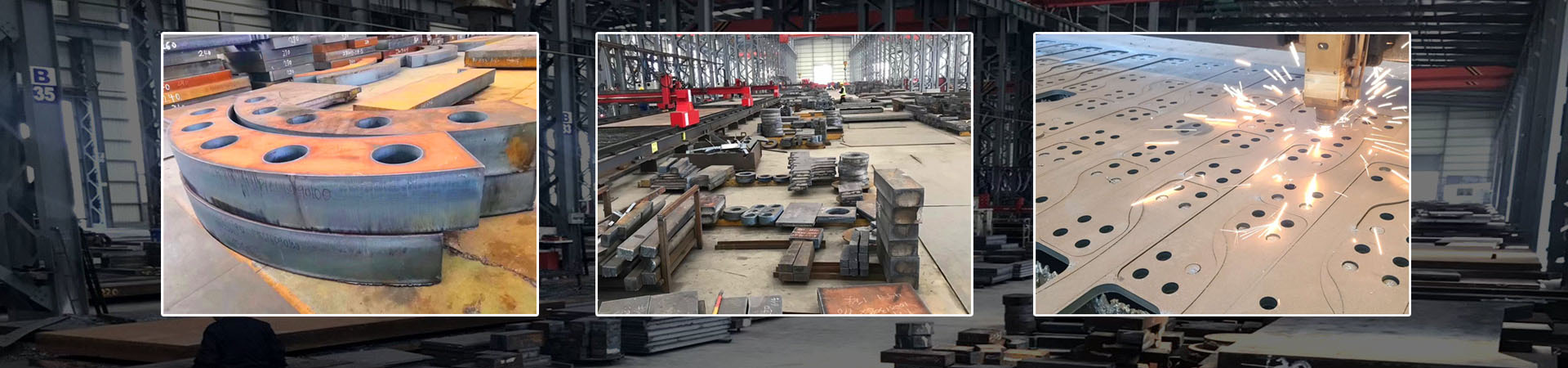
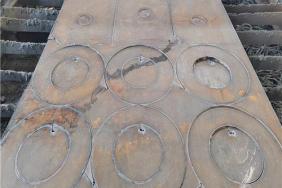
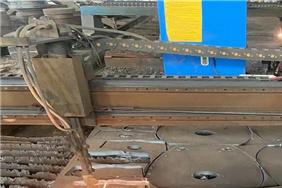
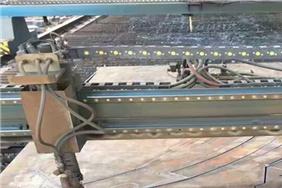
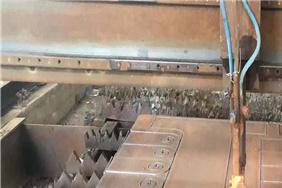
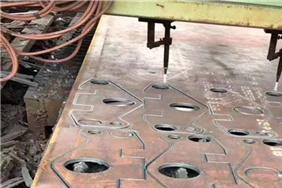
Applicable Materials: Carbon steel Q235 / Q355, blanking of large-size bases with thickness 10–200 mm Advantages: Ultra-low cost, capable of cutting extra-thick plates, high efficiency for blanking full large plates Disadvantages: Severe thermal deformation, rough cutting surface; high-precision bases require subsequent edge milling. Not suitable for stainless steel or wear-resistant high-strength steel. Process Flow: CAD drawing nesting → CNC flame cutting machine → rough cutting → oxide slag removal → finish milling Application Scenarios: Large machine tool bases, blanking of heavy-duty frames
2.2 Plasma Cutting (Medium & Thin Plates, Stainless Steel Bases)
- Ordinary Air Plasma: 3–30 mm carbon steel & stainless steel, thin equipment bases and support bottom plates
- Fine Plasma: 6–50 mm, smooth cutting surface, less deformation than flame cutting, semi-finished products for medium-small precision bases Advantages: Capable of cutting stainless steel and high-strength steel, fast cutting speed Limitations: Unable to process plates thicker than 200 mm, dross forms on cutting edges
2.3 Fiber Laser Cutting (High-precision Light-duty Bases & Stainless Steel Bases)
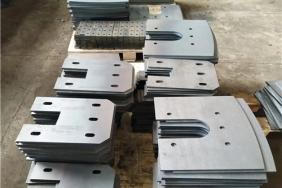
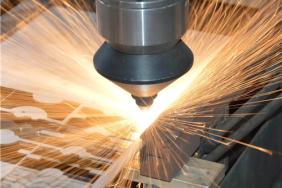
Applicable Thickness: 0.5–30 mm thin & medium plates, mass-produced precision equipment bases and stainless steel frames Advantages: Dimensional tolerance ±0.05 mm, cutting edges free of secondary polishing, low thermal deformation, one-step forming of small holes and special-shaped cutouts Drawbacks: Extremely high processing cost for plates over 30 mm, not fit for blanking oversized heavy-duty bases
2.4 Waterjet Cutting (Special Materials, Zero Thermal Deformation Bases)
Applicable Materials: Stainless steel, wear-resistant plates, clad steel plates, thin plates susceptible to thermal deformation Features: Cold cutting without thermal stress or deformation, no change to material mechanical properties Shortcomings: Slow cutting speed, high processing fee; only for small-batch high-precision anti-corrosion & wear-resistant bases
2.5 Saw Cutting (High-precision Standard Rectangular Base Blanks)
Equipment: Metal Band Saw, Gantry Saw Applicable Workpieces: Square & rectangular thick base blanks, strip cutting of 45# steel, high-strength steel and stainless steel Advantages: Straight cutting edges, high dimensional precision, no oxide layer, direct feeding for machining Limitations: Unable to cut special shapes or arcs, only for linear plate splitting
2.6 Milling / Edge Planing (Finishing Process After Cutting, Not Blanking Cutting)
All heavy-duty bases rough-cut by flame or plasma require edge milling to eliminate thermally affected layers and guarantee flatness for base assembly and splicing.
3. Matching Scheme of Base Material & Cutting Process
- Light Fan / Control Cabinet Base (Q235B, 6–16 mm): Mass production → Fiber Laser Cutting; Small Single Pieces → Plasma Cutting
- Standard Heavy Machine Tool Base (Q355B, 30–100 mm): CNC Flame Cutting + Subsequent Edge Milling
- Export Equipment Base (S355JR, 20–60 mm): Fine Plasma / Flame Cutting, unified edge milling for weld grooves for export standards
- Mining Crusher Base (Q690, 60–150 mm): High-power dedicated flame cutting with strict control of thermal deformation
- Food & Chemical Stainless Steel Base (304, 8–25 mm): Fiber Laser / Waterjet Cutting to avoid high-temperature oxidation
- Precision Grinder Integral Base (HT250 Cast Iron): Sand casting forming, no plate cutting procedures
4. Key Cutting Notes Specialized for Machine Bases
- Extra-thick bases cut by flame need stress relief aging treatment to release cutting stress and prevent warping deformation in later service.
- Reduce cutting speed when processing Q690 high-strength steel to avoid hardened cutting edges and subsequent welding cracking.
- Weld grooves for base assembly shall be uniformly processed by edge milling instead of retaining original cutting grooves.
- Wear-resistant clad plate bases are strictly forbidden to be processed by flame cutting; only waterjet or fine plasma cutting is allowed to prevent peeling of wear-resistant layers.